Enterprise AI Agents: Autonomous Workflow Orchestration for Business
Process Automation
A global logistics and supply chain company processed over 50,000
manual operational workflows daily — invoice approvals, shipment
tracking exceptions, customs documentation, and customer routing
inquiries — consuming hundreds of human hours and creating costly
delays. Spundan deployed a multi-agent AI system with specialized
autonomous agents that reason, plan, and execute complex business
processes across 12+ enterprise systems, reducing manual intervention
by 84% and cutting workflow completion time from hours to minutes.
The Challenge
The logistics company's operations were drowning in manual processes
that traditional automation (RPA, scripts, workflows) couldn't handle
due to variability, exceptions, and complex decision-making:
35% of shipment exceptions required human judgment and multi-system
cross-referencing, causing average resolution time of 4+ hours
Invoice approval workflows involved 7-12 steps across 5 different
systems with frequent data mismatches requiring manual reconciliation
Customs documentation varied by country, product type, and regulatory
changes — static rules failed constantly, requiring manual overrides
Customer support queries for shipment status, rerouting, and
documentation required agents to manually query 3-6 systems per
request
Operations team spent 60% of their time on information gathering and
data entry rather than exception handling and customer engagement
No unified way to handle "unstructured workflows" — email requests,
PDF attachments, phone call follow-ups that didn't fit rigid
automation paths
Peak periods (holiday shipping, weather disruptions) caused massive
backlogs with 48-72 hour delays in exception processing
Legacy automation tools broke whenever systems updated or API formats
changed, requiring constant maintenance
The Solution: A Multi-Agent Enterprise AI Workforce
Spundan designed and deployed a production multi-agent system where
specialized AI agents collaborate autonomously to execute complex
business processes, handling exceptions, querying systems, making
decisions, and escalating only when necessary:
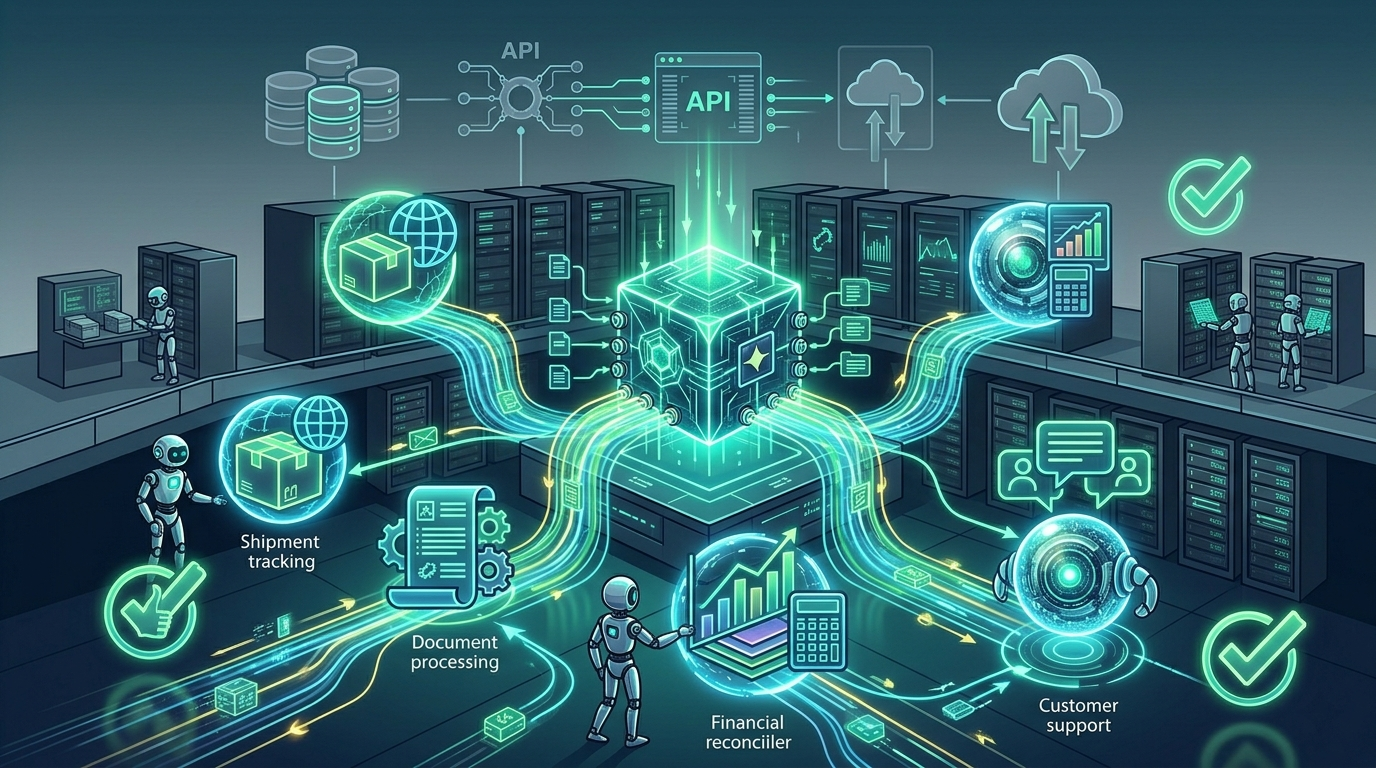
Orchestrator Agent: A central planning agent that
receives workflow requests, decomposes them into tasks, assigns work
to specialized agents, monitors execution, and handles handoffs — the
"conductor" of the agentic system.
Shipment Intelligence Agent: Specialized agent with
access to tracking systems, carrier APIs, weather data, and historical
patterns — autonomously diagnoses exceptions (delays, misrouts,
damages), predicts impact, and recommends or executes rerouting
actions.
Document Processing Agent: Ingests unstructured
documents (PDF invoices, customs forms, email attachments, scanned
PODs), extracts key fields using vision-language models, validates
against business rules, and routes to downstream systems or human
review only when confidence is low.
Financial Reconciliation Agent: Matches invoices
against purchase orders, shipment records, and contracts — identifies
discrepancies, communicates with vendor agents or internal systems to
resolve variances, and flags only complex mismatches for human review.
Customer Support Agent: Handles inbound inquiries via
chat and email, retrieves real-time shipment data, provides proactive
updates, and executes customer requests (address changes, delivery
holds, expedite requests) by calling downstream APIs.
Tool Use & System Integration: All agents equipped
with function-calling capabilities to query internal APIs, update
databases, send emails, create tickets, and trigger external workflows
— with full audit trails of every action taken.
Human-in-the-Loop Escalation: Built configurable
confidence thresholds where agents automatically escalate to human
operators for ambiguous cases, high-value decisions, or when
encountering novel scenarios — with full context preservation.
Agent Observability & Improvement: Deployed tracing
and logging for every agent decision, task completion, and tool call —
enabling continuous refinement of prompts, tool definitions, and
escalation rules based on production data.
Implementation Steps
The multi-agent system was built iteratively, starting with the
highest-volume, highest-friction workflows and expanding agent
capabilities over time:
Workflow Discovery & Prioritization: Analyzed 6
months of operational data to identify top 20 workflows by volume,
manual effort, and exception rate — prioritized shipment exception
handling and invoice reconciliation as pilot use cases.
Agent Architecture Design: Selected CrewAI as the
multi-agent framework with LangGraph for stateful workflows, deployed
on Kubernetes with auto-scaling for variable workload volumes.
Tool Development: Built 35+ tool definitions wrapping
internal APIs, database queries, and external carrier services — with
standardized error handling, rate limiting, and retry logic.
Agent Prompt Engineering: Developed system prompts
for each agent with clear role definitions, available tools,
escalation criteria, and chain-of-thought reasoning templates —
iteratively refined using production trace data.
Human-in-the-Loop Integration: Built a review queue
interface where escalated cases appear with full conversation history,
agent reasoning, and suggested actions — enabling one-click approval
or modification.
Shadow Mode Testing: Ran agents in "shadow mode" for
4 weeks — executing workflows in parallel without taking live actions
— comparing agent decisions against historical human outcomes to
validate accuracy.
Phased Rollout: Enabled live execution starting with
low-risk workflows, gradually expanding to higher-value processes as
confidence metrics exceeded 95% accuracy thresholds.
Continuous Learning Pipeline: Implemented feedback
loops where human corrections and escalations become training data for
prompt refinement and tool improvements — deployed weekly agent
updates.
Results
The Enterprise AI Agents platform transformed the logistics company's
operations, delivering unprecedented automation while keeping humans
focused on high-value work:
Manual Effort Reduction: Achieved
84% reduction in manual intervention across automated workflows
— from 50,000 daily human actions to under 8,000 requiring any human
touch.
Workflow Speed: Average shipment exception resolution
dropped from 4.2 hours to 11 minutes — a 96% reduction in
resolution time for common exceptions.
Invoice Reconciliation: Financial reconciliation
agent processed 35,000+ invoices monthly with 97%
straight-through processing — down from 40% before deployment.
Customer Support Automation: AI agent resolved
68% of inbound inquiries without human agent involvement,
reducing average response time from 3 hours to 45 seconds.
Exception Handling: Shipment intelligence agent
autonomously resolved
73% of weather and carrier delay exceptions, proactively
notifying customers and adjusting ETAs without operations team
involvement.
Peak Performance: During holiday peak (2.5x normal
volume), agent system maintained 99.5% completion rates with
zero backlog — compared to previous years where backlogs exceeded 72
hours.
ROI: Delivered $4.2M annual cost savings from
reduced manual labor, faster exception resolution, and lower customer
compensation payouts from delayed responses.
Operator Satisfaction: Operations team NPS score
improved from -12 to +48, with staff reporting they could finally
focus on "actual problems" instead of repetitive data gathering and
system hopping.
Conclusion
The Enterprise AI Agents deployment proved that autonomous, multi-agent
systems are not just a research curiosity — they are production-ready
tools capable of transforming enterprise operations. By moving beyond
simple chatbots and RPA scripts to agentic systems that reason, plan,
and execute, the logistics company automated the cognitive work that had
previously required dozens of human agents. The platform now handles
millions of decisions monthly, scales effortlessly during peak periods,
and continues improving through continuous learning. Most importantly,
it freed human talent to focus on strategic exception handling, customer
relationships, and continuous improvement — exactly where human judgment
adds the most value.