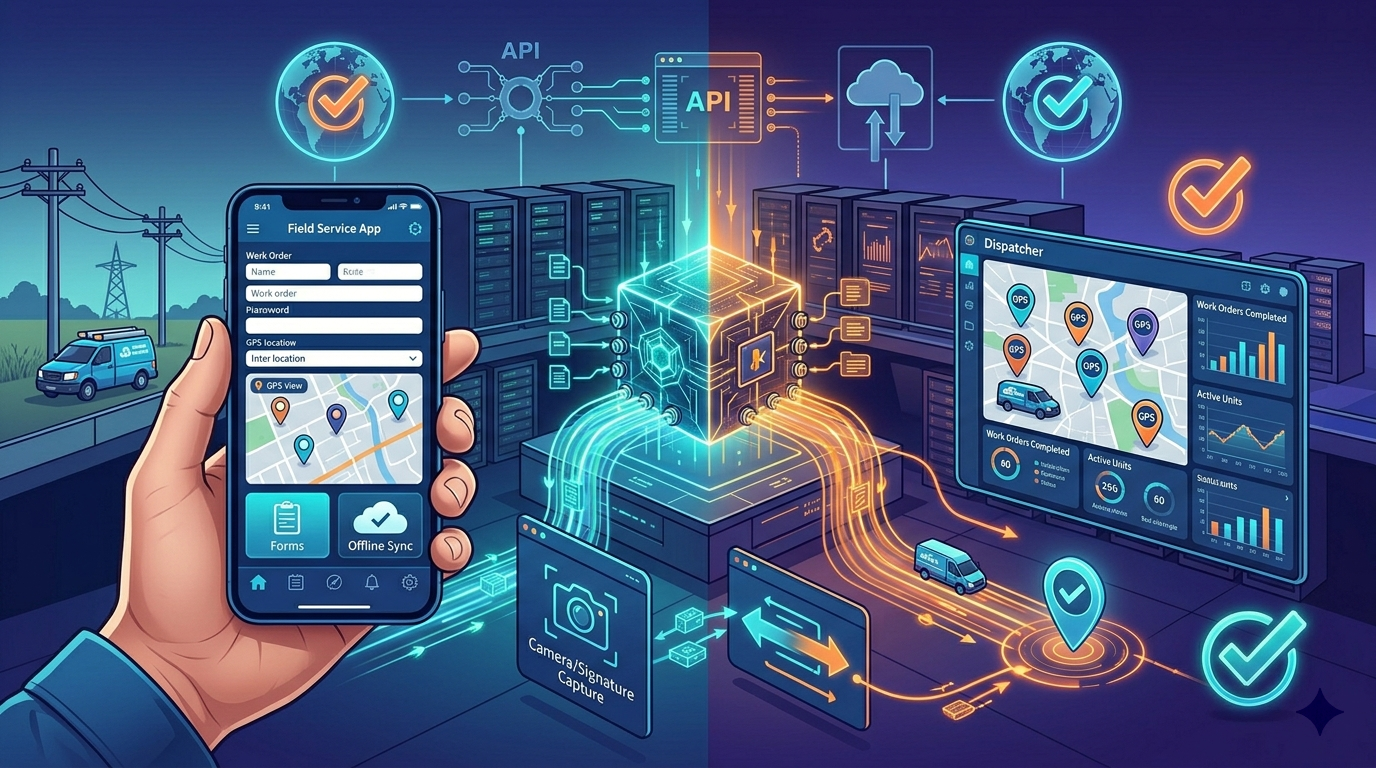
Mobile App Development - Cross-platform enterprise mobile solution for field workforce management

Mobile App Development: Cross-Platform Enterprise Solution for Field Workforce Management

A national utility company with 5,000+ field technicians struggled with outdated, paper-based workflows and fragmented mobile tools that worked offline poorly, crashed frequently, and provided no real-time visibility for dispatchers. Spundan built a unified cross-platform mobile application using React Native, delivering native-grade performance on both iOS and Android, offline-first capabilities, real-time GPS tracking, and seamless backend integration — reducing field ticket completion time by 62% and saving $8M annually in operational inefficiencies.

The Challenge

The utility company's field operations were crippled by fragmented, unreliable, and outdated mobile technology that impacted both technician productivity and customer satisfaction:

The Solution: A Unified Cross-Platform Mobile Platform

Spundan designed and built a single, unified mobile application using React Native that works flawlessly across iOS and Android, with offline-first architecture, real-time sync, and enterprise-grade reliability:

  1. Cross-Platform Architecture: Selected React Native with a shared codebase (95% code reuse) delivering consistent features, UX, and performance across both iOS and Android — eliminating platform disparity.
  2. Offline-First Design: Implemented WatermelonDB for local data persistence with automatic sync — technicians can download work orders, capture data, take photos, and record signatures entirely offline, with seamless sync when connectivity returns.
  3. Real-Time GPS & Location Services: Built battery-efficient location tracking with background geolocation, geofencing triggers, and route optimization — dispatchers see live technician positions and ETAs updated every 30 seconds.
  4. Rich Media Capture: Integrated camera, signature capture, barcode scanning, and file attachment capabilities with automatic compression, watermarking, and backend upload — eliminating paper forms completely.
  5. Push Notifications & Alerts: Deployed real-time push notifications for new work orders, schedule changes, emergency dispatches, and safety alerts — with read receipts and acknowledgment tracking.
  6. Seamless Backend Integration: Connected to existing ERP, CRM, and scheduling systems via REST APIs with intelligent caching, request queuing, and automatic retry logic for unreliable networks.
  7. CI/CD Pipeline: Automated build, test, and deployment pipeline using Fastlane and GitHub Actions — reducing release cycles from 6 weeks to daily updates with over-the-air (OTA) updates for critical fixes.
  8. Analytics & Performance Monitoring: Embedded Firebase Analytics and Sentry for crash reporting, user session tracking, and performance metrics — enabling data-driven improvements and rapid bug resolution.

Implementation Steps

The mobile app was developed iteratively with continuous feedback from field technicians and dispatchers, ensuring the solution solved real-world problems:

Results

The new mobile platform transformed field operations, delivering dramatic improvements in productivity, data accuracy, and technician satisfaction:

Conclusion

The cross-platform mobile app development project proved that a unified, offline-first approach can deliver enterprise-grade reliability while dramatically reducing development costs and time-to-market. By choosing React Native and investing in offline architecture, the utility company transformed field operations from a source of customer frustration into a competitive advantage. Technicians now carry a powerful tool that works everywhere, dispatchers have real-time visibility, and the business saved millions annually. The platform continues to evolve, with new features shipping weekly instead of quarterly, and serves as the foundation for the company's broader digital transformation initiative.